
- Disability and difference
- Inclusion
- Belonging
- Ages 4 to 10
Disability Is Normal
Treat disabled people as people, not as lessons
Dr. Russ L'HommeDieu, DPT, C-AAIS and Karen L'HommeDieu, LMSW3 min readNatural-voice narration
Listen to this article
Read aloud in a natural voice. Pick any section to start there.
Where we stand
Treat disabled people as people, not as lessons. A child with limb loss does not exist to inspire the rest of us; they deserve to be seen for who they are and what they do, with their body treated as an ordinary fact about them.
Ezra Frech
Ezra Frech shows what this looks like. He was born without most of his left leg (opens in a new tab) and won two gold medals at the 2024 Paralympics. In November 2026 he and his partner, Daniella Karagach, won Dancing with the Stars (opens in a new tab). In their last dance his prosthetic leg would not stay on and came off mid-routine. His partner told him to put it back on, they finished, and the judges gave the dance a perfect score. Earlier in the season a judge praised him as an inspiration to the "differently abled" community. He thanked her and spoke of the disabled community instead (opens in a new tab).
Frech has said that normalizing disability matters more than treating it as an exception (opens in a new tab), and he credits the disabled contestants who came before him.
Three parts
- Disability is not a tragedy to overcome. It is one way of having a body. Ezra's prosthetic is equipment he uses, like glasses.
- Keep belonging and praise separate. A child belongs because they are here, not because of what they can do. Praise is a different thing, and it should be honest and specific. Ezra earned praise for the dancing, which was hard for anyone. Inflated praise for ordinary things tells a child we expected nothing, and it can backfire for children who already doubt themselves (Brummelman et al., 2014).
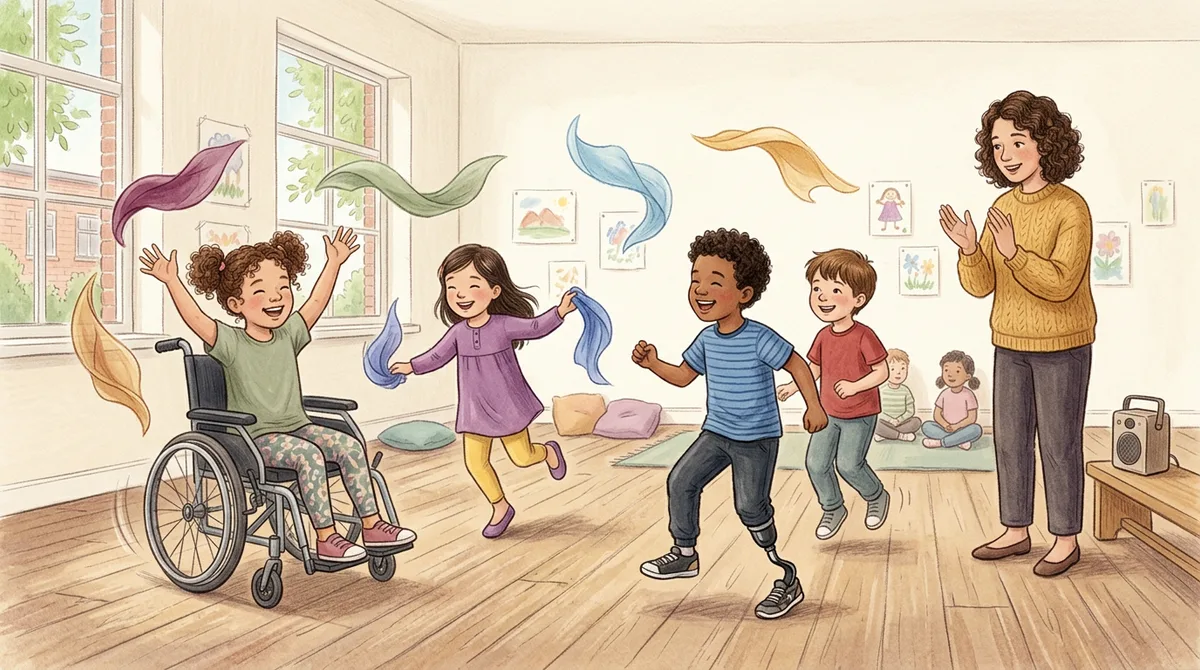
- Inclusion is the room's job. Including someone is the work of everyone around them. When Ezra's leg came off, his partner changed what she was doing and the dance went on. In a classroom, that means the adults, the classmates and the space all adjust, so the child with a disability is not the only one adapting.
For a young reader, in Daisy's voice, it comes down to: "You don't have to be amazing to belong here. You already do."
A caution about our own example
Ezra Frech is a champion, and a champion is a risky example. Researchers who study Paralympic coverage describe a "supercrip" story, in which a disabled person is celebrated as superhuman for overcoming the odds (Silva & Howe, 2012). Most children with limb loss will never win a medal, and they should not have to.
Worth that depends on performance is fragile. In a large study of adults, self-compassion went with steadier feelings of self-worth than self-esteem did, and it depended less on particular outcomes (Neff & Vonk, 2009). College students who felt that their parents' regard depended on how they performed reported more fluctuating self-esteem and more resentment (Assor et al., 2004). Both studies were done with adults.
So we hold two things at once. Notice what a child really does, and make sure belonging never depends on it.
How Daisy can help
- Same goal, different way. In Find Your Special Way (opens in a new tab), children learn how real tools help people reach the same goal in different ways.
- Fix the place. In Barrier Busters (opens in a new tab), children find the barrier in a place and choose the fix.
- Related reading. Why Does She Only Have Three Legs? covers answering children's questions about disability, with the research behind it.
Sources
- Good Morning America, season 35 champion report (opens in a new tab), November 25, 2026
- InTouch Weekly, republished by Yahoo Entertainment, report on the semifinal exchange (opens in a new tab)
- Dance Mogul, article on Frech and disability representation (opens in a new tab)
- Wikipedia, Ezra Frech (opens in a new tab)
Every study cited in this article is listed with a link in .
References
Sources are listed in APA style. Links open the original publication in a new tab.
Assor, A., Roth, G., & Deci, E. L. (2004). The emotional costs of parents' conditional regard: A self-determination theory analysis. Journal of Personality, 72(1), 47–88. https://doi.org/10.1111/j.0022-3506.2004.00256.x (opens in a new tab)
Brummelman, E., Thomaes, S., Orobio de Castro, B., Overbeek, G., & Bushman, B. J. (2014). "That's not just beautiful, that's incredibly beautiful!": The adverse impact of inflated praise on children with low self-esteem. Psychological Science, 25(3), 728–735. https://doi.org/10.1177/0956797613514251 (opens in a new tab)
Neff, K. D., & Vonk, R. (2009). Self-compassion versus global self-esteem: Two different ways of relating to oneself. Journal of Personality, 77(1), 23–50. https://doi.org/10.1111/j.1467-6494.2008.00537.x (opens in a new tab)
Silva, C. F., & Howe, P. D. (2012). The (in)validity of supercrip representation of Paralympian athletes. Journal of Sport & Social Issues, 36(2), 174–194. https://doi.org/10.1177/0193723511433865 (opens in a new tab)