
- Social-emotional learning
- Empathy
- Compassion
- Ages 4 to 10
Feeling With and Caring For
Why young children need both empathy and compassion
Dr. Russ L'HommeDieu, DPT, C-AAIS and Karen L'HommeDieu, LMSW8 min readNatural-voice narration
Listen to this article
Read aloud in a natural voice. Pick any section to start there.
Introduction
Families are asking for empathy. In a 2026 Sesame Workshop survey of 2,080 caregivers of children ages 3 to 8, 64% said they value empathy over manners in their child, a 24 point swing from 2016. Another 56% chose compassion over confidence (Turner, 2026).
That is good news for anyone who teaches young children. It also raises a question the survey did not ask: are empathy and compassion the same thing? The research says no. Centuries of contemplative practice say no. The difference matters most for the tender-hearted children in your room.
Empathy and compassion are not the same thing
Empathy is feeling with someone. Compassion is caring about their hurt and wanting to help. Researchers define empathy as sharing another person's feeling while knowing the feeling belongs to that other person (Singer & Klimecki, 2014). Compassion adds warmth and a pull toward the person. A major review found it is a distinct emotion that moves us to approach the person suffering, and that it differs from distress and sadness (Goetz et al., 2010).
In child language:
- Empathy: "I feel sad because you feel sad."
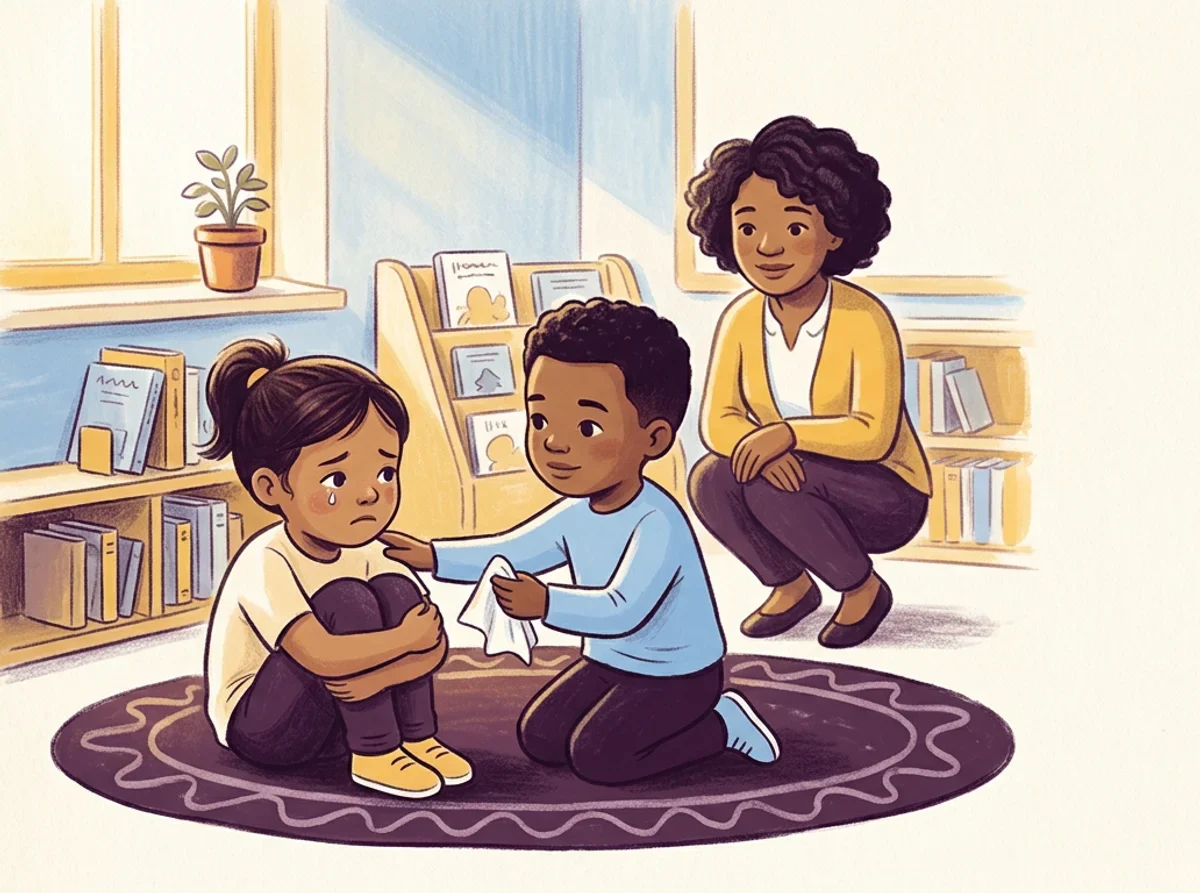
- Compassion: "I see you are sad. I care. How can I help?"
Empathy is where caring starts. It is not where it should stop.
When empathy overwhelms
Shared feeling with no way to manage it can turn into empathic distress, and distressed children help less. You have seen it. One child cries, and another covers her ears, melts down, or walks away. She is not being unkind. She is overwhelmed.
The research matches what you see:
- Distress and concern lead to different behavior. In a study that tracked children's faces while they watched someone in need, children who showed concern were more likely to help. Children who showed distress were less likely to help (Eisenberg et al., 1989).
- Regulation is part of healthy empathy. Emotion regulation and self-awareness are core components of mature empathy, alongside shared feeling (Decety & Jackson, 2004).
- Deep feelers can carry real risk. One review calls empathy a "risky strength." In sensitive children, strong empathy can lead to personal distress and excessive guilt, which raise risk for anxiety and depression. The authors urge building healthy empathic skills early (Tone & Tully, 2014). It is likely what they mean by "empathic skills" is that empathy needs to pair with compassion.
- Empathy practice alone can make people feel worse. When adults were trained only to resonate with others' suffering, their negative feelings rose (Klimecki et al., 2014).
So "imagine how she feels" is only half a lesson. Children also need to know what to do with the feeling.
Compassion grows with practice
Compassion works like a muscle: it gets stronger when it is used. In the same adult study, compassion training that followed empathy training reversed the rise in negative feelings and increased positive ones. The researchers describe compassion as a way to overcome empathic distress and build resilience (Klimecki et al., 2014). Other adult studies found that compassion training increased generous behavior toward a stranger (Weng et al., 2013) and, over 9 months of daily practice, changed brain structure in step with gains in compassion (Valk et al., 2017).
Studies with children point the same way:
- Preschoolers. A 12 week Kindness Curriculum, tested in a randomized trial with 68 preschoolers, improved social competence and social-emotional report card grades. Children without it grew more selfish over the same period (Flook et al., 2015).
- Ages 9 to 11. Students who did three kind acts a week for 4 weeks became better accepted by their peers than a comparison group (Layous et al., 2012).
A fair caution: the brain and training studies were done with adults, and no study has yet compared empathy-only teaching with compassion teaching in young children. What the child research does show is that concern helps, distress hinders, and regular practice of kindness pays off.
When helping is not possible, caring still counts
Compassion does not require fixing anything. The sincere wish to ease someone's suffering is already compassion. A systematic review of definitions found five elements: recognizing suffering, understanding that suffering is universal, feeling for the person, tolerating uncomfortable feelings, and motivation to act or acting to relieve it (Strauss et al., 2016). Motivation stands beside action in that list, and staying present with discomfort is part of the definition.
The laboratory evidence makes the same point, because participants in these studies could do nothing for the people they perceived as suffering:
- Watching suffering with a caring intention. Adults trained in compassion watched videos of people in distress. They could not intervene, yet their positive feelings rose and brain regions tied to affiliation and reward became more active (Klimecki et al., 2013, 2014).
- The caring comes from inside. Experienced practitioners who met film clips of distress with compassion felt more positive affect than when they simply watched. The brain network involved was active before the clips appeared, which suggests the benefit came from warmth they generated themselves, not from changing the situation (Engen & Singer, 2015).
- A few minutes of kind wishes. A brief loving-kindness exercise, which consists of silently wishing others well, increased feelings of connection and positivity toward strangers (Hutcherson et al., 2008).
This matters in early childhood because most of the suffering young children meet is beyond their power to fix. A classmate's pet dies. A grandparent is in the hospital. A friend moves away. A storm is on the news. If children learn that compassion always means fixing, then suffering they cannot fix leaves them only two choices: carry the distress or turn away.
The kind wish offers a third. You might say: "We cannot make Maya's grandpa better. We can hold a kind wish for him. May he feel safe. May he feel loved." Sitting quietly beside a sad friend while silently wishing them well counts too.
These were adult studies, and the Engen and Singer study involved only 15 expert practitioners. Whether kind-wish practice protects young children in the same way has not been tested in the research reviewed here. It is a reasonable extension, not a proven result.
What this looks like in your classroom
Teach a simple sequence: notice, calm, care, then help or send a kind wish. These six practices are our suggestions drawn from the research above, not a tested program.
- Name both words. Teach "feeling with" and "helping with" as two different things. When you see either one, say which it was.
- Calm first. A flooded child cannot help anyone. Before asking a child to respond to a hurt friend, give them a breath, a pause, or a quiet spot. Regulation is what keeps empathy from tipping into distress (Decety & Jackson, 2004). Calming Breaths (opens in a new tab) offers 16 guided breaths of 1 to 3 minutes each, paced by age.
- Offer one small job. Turn the feeling into action a child can manage: get a tissue, sit beside, invite into the game, tell a teacher. Action gives the feeling somewhere to go. When nothing can be done, the kind wish is the job: "I hope you feel better soon."
- Train the kind wish. Intention is a skill, so rehearse it before it is needed. In adults, a few minutes of wishing others well raised feelings of connection (Hutcherson et al., 2008). Kind Wishes with Daisy (opens in a new tab) is a free 5 to 10 minute guided game. A calm voice leads children to send kind wishes in widening circles: to themselves, their family, their class, the whole world, and people who are not nice to them. Every wish is spoken aloud, so pre-readers can join on a smartboard or with headphones. The last circle is optional. It does not mean forgiving anyone or staying near someone who hurts them, and any child can skip it. Afterward, ask how their body felt and who they would like to send a kind wish to tomorrow.
- Practice on a schedule. Kindness that showed results was practiced weekly for weeks, not taught once (Flook et al., 2015; Layous et al., 2012). Try a standing routine, such as three kind acts a week that children plan and report on, or a kind wishes circle to open each Monday.
- Watch your deep feelers. The child who cries when others cry, or worries long after a classmate's bad day, needs steps 2, 3 and 4 most. Reassure them that noticing is a strength and that the hurt is not theirs to carry alone (Tone & Tully, 2014).
One more thing: let children see you do it. Say your own steps out loud. "I can see Marcus is upset. I am taking a breath. Now I am going to ask what he needs."
How Daisy can help
The Daisy books give you a story for each step. Daisy is a real three-legged therapy dog, and her stories are written for ages 4 to 10.
| Step | Book | What children see | Free games to pair |
|---|---|---|---|
| Notice | Daisy's Different | After losing a leg, Daisy is teased and passed over, then learns that different does not mean broken | 7 games (opens in a new tab), including Feelings Path and Find Your Special Way |
| Calm | Daisy Can't Help It | A twist in Daisy's tummy grows into a storm of feelings. Her family answers with compassion and a feelings chart | 10 games (opens in a new tab), including Calming Breaths, Feelings Detective, Surf the Urge and Daisy's Calm Corner |
| Care and help | Daisy Dives In | Daisy relearns to swim on three legs and finds the courage to help an injured manatee | The Kindness Choice and Be a Defender (with the Daisy's Different games); Be Like Tuck and Make It Right (with the Daisy Can't Help It games); 7 water games (opens in a new tab) |
| Wish well | Any Daisy book | Caring still counts when there is nothing to fix | Kind Wishes with Daisy (opens in a new tab), with a teacher page (opens in a new tab) |
| Keep helping | Daisy & The Big Storm (book coming soon, educator guide ready now) | Helpers are everywhere, and becoming a helper makes you feel brave | 12 storm-safety games (opens in a new tab) |
Where to find everything:
- Educator site. Sign in at threepawspublishing.education (opens in a new tab) for each book's read-along for the classroom screen, a narrated read-along, an interactive teacher's guide and a printable PDF guide. The printable Daisy Activity Book is there too, with coloring, a maze and a feelings match.
- Games. Everything at threepawspublishing.games (opens in a new tab) is free in the browser with no account, so children can play at school or at home. Each main game has a teacher page with objectives, discussion questions and an extension activity.
- Visits. Daisy visits K to 5 schools for assemblies, classroom reads and library events. Details are at threepawspublishing.com (opens in a new tab).
The games are general calming and feelings practice, not therapy. If a child seems very upset, involve your school counselor or social worker.
Empathy lets a child notice. Compassion lets a child care, and help when help is possible. Children deserve both, and both can be taught.
Every study cited in this article is listed with a link in .
References
Sources are listed in APA style. Links open the original publication in a new tab.
Decety, J., & Jackson, P. L. (2004). The functional architecture of human empathy. Behavioral and Cognitive Neuroscience Reviews, 3(2), 71–100. https://doi.org/10.1177/1534582304267187 (opens in a new tab)
Eisenberg, N., Fabes, R. A., Miller, P. A., Fultz, J., Shell, R., Mathy, R. M., & Reno, R. R. (1989). Relation of sympathy and personal distress to prosocial behavior: A multimethod study. Journal of Personality and Social Psychology, 57(1), 55–66. https://doi.org/10.1037/0022-3514.57.1.55 (opens in a new tab)
Engen, H. G., & Singer, T. (2015). Compassion-based emotion regulation up-regulates experienced positive affect and associated neural networks. Social Cognitive and Affective Neuroscience, 10(9), 1291–1301. https://doi.org/10.1093/scan/nsv008 (opens in a new tab)
Flook, L., Goldberg, S. B., Pinger, L., & Davidson, R. J. (2015). Promoting prosocial behavior and self-regulatory skills in preschool children through a mindfulness-based Kindness Curriculum. Developmental Psychology, 51(1), 44–51. https://doi.org/10.1037/a0038256 (opens in a new tab)
Goetz, J. L., Keltner, D., & Simon-Thomas, E. (2010). Compassion: An evolutionary analysis and empirical review. Psychological Bulletin, 136(3), 351–374. https://doi.org/10.1037/a0018807 (opens in a new tab)
Hutcherson, C. A., Seppala, E. M., & Gross, J. J. (2008). Loving-kindness meditation increases social connectedness. Emotion, 8(5), 720–724. https://doi.org/10.1037/a0013237 (opens in a new tab)
Klimecki, O. M., Leiberg, S., Lamm, C., & Singer, T. (2013). Functional neural plasticity and associated changes in positive affect after compassion training. Cerebral Cortex, 23(7), 1552–1561. https://doi.org/10.1093/cercor/bhs142 (opens in a new tab)
Klimecki, O. M., Leiberg, S., Ricard, M., & Singer, T. (2014). Differential pattern of functional brain plasticity after compassion and empathy training. Social Cognitive and Affective Neuroscience, 9(6), 873–879. https://doi.org/10.1093/scan/nst060 (opens in a new tab)
Layous, K., Nelson, S. K., Oberle, E., Schonert-Reichl, K. A., & Lyubomirsky, S. (2012). Kindness counts: Prompting prosocial behavior in preadolescents boosts peer acceptance and well-being. PLoS ONE, 7(12), Article e51380. https://doi.org/10.1371/journal.pone.0051380 (opens in a new tab)
Singer, T., & Klimecki, O. M. (2014). Empathy and compassion. Current Biology, 24(18), R875–R878. https://doi.org/10.1016/j.cub.2014.06.054 (opens in a new tab)
Strauss, C., Lever Taylor, B., Gu, J., Kuyken, W., Baer, R., Jones, F., & Cavanagh, K. (2016). What is compassion and how can we measure it? A review of definitions and measures. Clinical Psychology Review, 47, 15–27. https://doi.org/10.1016/j.cpr.2016.05.004 (opens in a new tab)
Tone, E. B., & Tully, E. C. (2014). Empathy as a "risky strength": A multilevel examination of empathy and risk for internalizing disorders. Development and Psychopathology, 26(4, Pt. 2), 1547–1565. https://doi.org/10.1017/S0954579414001199 (opens in a new tab)
Turner, C. (2026, November 23). K is for kindness, but families worry the world has less of it. NPR. As carried by KPBS: https://www.kpbs.org/news/education/2026/11/23/k-is-for-kindness-but-families-worry-the-world-has-less-of-it (opens in a new tab)
Valk, S. L., Bernhardt, B. C., Trautwein, F.-M., Böckler, A., Kanske, P., Guizard, N., Collins, D. L., & Singer, T. (2017). Structural plasticity of the social brain: Differential change after socio-affective and cognitive mental training. Science Advances, 3(10), Article e1700489. https://doi.org/10.1126/sciadv.1700489 (opens in a new tab)
Weng, H. Y., Fox, A. S., Shackman, A. J., Stodola, D. E., Caldwell, J. Z. K., Olson, M. C., Rogers, G. M., & Davidson, R. J. (2013). Compassion training alters altruism and neural responses to suffering. Psychological Science, 24(7), 1171–1180. https://doi.org/10.1177/0956797612469537 (opens in a new tab)