
- Social-emotional learning
- Self-regulation
- Co-regulation
- Ages 4 to 10
Big Feelings Are Not Misbehavior
Why co-regulation comes before self-regulation
Dr. Russ L'HommeDieu, DPT, C-AAIS and Karen L'HommeDieu, LMSW6 min readNatural-voice narration
Listen to this article
Read aloud in a natural voice. Pick any section to start there.
Introduction
In Daisy Can't Help It, Mom and Dad leave for an errand. A tiny twist in Daisy's tummy grows into a storm of feelings, and the family comes home to a chewed-up mess. They do not scold. They answer with compassion and a feelings chart.
Every teacher has met that storm: the thrown block, the torn paper, the child under the table. The common response is "calm down" or "use your words." Both assume the child already has a skill that is still under construction. The research points to a different order of operations. Children learn to regulate themselves by first being regulated with someone.
Self-regulation is built, not born
Self-regulation is the ability to manage feelings, attention and behavior in order to reach a goal. It grows quickly in the early years and keeps improving, more slowly, into adulthood (Eisenberg et al., 2010). It is also one of the foundations of school readiness, because it is what lets a child stay with a learning task at all (Blair & Raver, 2015).
It matters for a long time:
- Across decades. A study that followed 1,000 children from birth to age 32 found that childhood self-control predicted adult health, finances and criminal offending, even after accounting for intelligence and social class (Moffitt et al., 2011).
- From kindergarten on. Kindergarten teachers' ratings of children's social-emotional skills were linked to education, employment and mental health outcomes 13 to 19 years later (Jones et al., 2015).
The important word is develops. A five-year-old who falls apart is not refusing to use a skill. In most cases the skill is not finished yet.
What co-regulation is
Co-regulation is the support a caring adult gives while a child's own regulation is still growing. A federal practice brief describes three parts (Rosanbalm & Murray, 2017):
- A warm, responsive relationship. The child knows the adult is on their side, including in hard moments.
- A structured environment. Predictable routines, clear expectations and a safe place to settle.
- Teaching and coaching skills. Naming feelings, modeling calming strategies, and practicing them when things are calm.
The brief makes the point that self-regulation depends on predictable, responsive adults and environments at every age, and that the support changes shape as the child's capacity grows. A review of family research describes the same pathways: children learn emotion regulation by watching the adults around them, through the way adults respond to their feelings, and through the emotional climate they live in (Morris et al., 2007).
Daisy's family does all three. They stay warm, they give her a feelings chart, and Mom teaches her tools to use next time.
Why "calm down" does not work
A flooded child cannot follow a verbal instruction to stop being flooded. What helps is a calm adult nearby and a word for the feeling.
- Naming helps. In a brain imaging study with adults, putting a feeling into words lowered the response of the amygdala, a region tied to emotional reactivity (Lieberman et al., 2007).
- Coaching beats directing. In video observations of 19 preschool groups, teachers supported children's self-regulation of negative emotions when they used emotion coaching and asked children for their own ideas about how to handle the feeling (Silkenbeumer et al., 2024).
- Emotional support protects. In a national study of 910 children, those identified as at risk in kindergarten did as well as their low-risk peers by the end of first grade when their classrooms offered strong emotional and instructional support. In less supportive classrooms they had lower achievement and more conflict with teachers (Hamre & Pianta, 2005).
So the behavior is information. It tells you which skill is missing and how much support the child needs right now.
The skills can be taught
Regulation skills respond to teaching. A meta-analysis of 213 school-based social and emotional learning programs, covering 270,034 students from kindergarten through high school, found better social and emotional skills, better behavior and an 11 percentile point gain in academic achievement (Durlak et al., 2011). In a randomized trial with 68 preschoolers, a 12 week Kindness Curriculum improved social competence, with small to medium effects on delay of gratification (Flook et al., 2015).
A fair caution: the affect labeling study was done with adults. The long-term studies show association, not proof of cause. And no study cited here tested co-regulation as a stand-alone classroom program. What the evidence does support is the sequence: warm adult first, skills second, independence last.
What this looks like in your classroom
Teach a simple order: connect, calm, name, then teach. These six practices are our suggestions drawn from the research above, not a tested program.
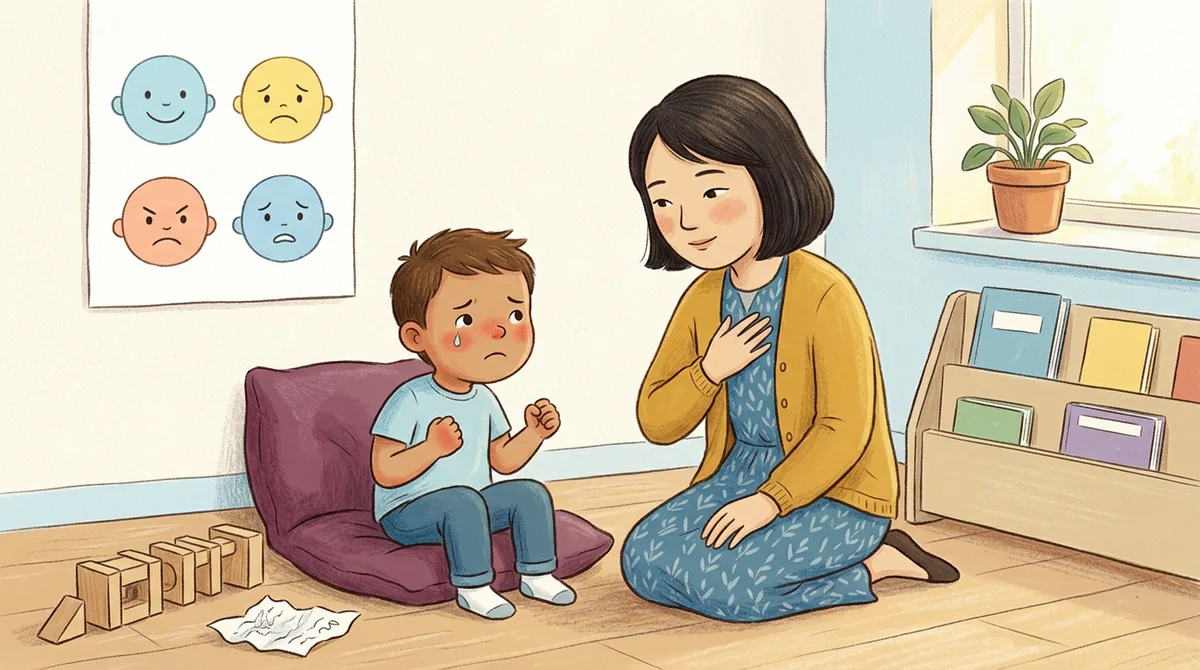
- Regulate yourself first. Children borrow your calm. Lower your voice, slow your breath and get down to eye level before you speak. Say your own steps out loud: "I am taking a slow breath so I can help."
- Connect before you correct. Lead with the relationship: "You are having a hard time. I am right here." The lesson about the block can wait five minutes. It will land better then.
- Name the feeling. Give the child the word: "That looks like frustrated." Use a feelings chart, as Daisy's family does. Feelings Detective (opens in a new tab) lets children practice by picking the face that shows how Daisy feels, and What Happened Here? (opens in a new tab) has them find the feeling behind each part of Daisy's mess.
- Build a calm corner, and teach it when no one is upset. A calm space is a tool, not a punishment. Introduce it during a quiet moment and practice going there. Daisy's Calm Corner (opens in a new tab) and Calming Breaths (opens in a new tab) (16 guided techniques of 1 to 3 minutes each, including Daisy's "smell the daisy, blow out the candle") work on a smartboard or a calm corner device.
- Rehearse the tools before the storm. Skills practiced while calm are the ones available under stress. Mom gives Daisy three tools: "I'm OK right now," surfing the wave, and smelling the daisies and blowing out the candles. Before the Chomp (opens in a new tab) lets children rewind three moments from the book and try each one. Surf the Urge (opens in a new tab) teaches that an urge rises, peaks and gets smaller, and Worry or Right Now? (opens in a new tab) sorts worry thoughts from "I'm OK right now" thoughts.
- Repair without shame. When the storm has passed, help the child fix what can be fixed and then move on. Daisy's family cleans up with her and still loves her. Make It Right (opens in a new tab) gives children practice with that step.
As children grow, hand over more of the work. Ask "What could help right now?" before you offer the answer. That question is the bridge from co-regulation to self-regulation.
How Daisy can help
| Step | What children see in Daisy Can't Help It | Free games to pair |
|---|---|---|
| Connect | Daisy's family answers the mess with compassion, not scolding | What Happened Here? (opens in a new tab) |
| Calm | Smell the daisies, blow out the candles | Calming Breaths (opens in a new tab), Daisy's Calm Corner (opens in a new tab) |
| Name | The feelings chart | Feelings Detective (opens in a new tab), Worry or Right Now? (opens in a new tab) |
| Teach | Mom's three tools for next time | Before the Chomp (opens in a new tab), Surf the Urge (opens in a new tab) |
| Repair | Cleaning up together and moving on | Make It Right (opens in a new tab) |
Where to find everything:
- Educator site. Your classroom resources page has the read-along for the classroom screen, a narrated read-along and the printable guide. The interactive teacher's guide for Daisy Can't Help It has full sections on co-regulation, the science of emotions, mindfulness and self-compassion, with lesson plans by grade band.
- Games. All 10 Daisy Can't Help It games (opens in a new tab) are free in the browser with no account. Each has an Explain the Game card with objectives and classroom notes, for example the Calming Breaths card (opens in a new tab).
- Related reading. Feeling With and Caring For explains why a calm child is also a child who can help a friend.
The games are general calming and feelings practice, not therapy. If a child's big feelings are frequent, intense or getting worse, involve your school counselor or social worker.
A child in a storm is not giving you a hard time. The child is having a hard time. Lend your calm first. The skills come after.
Every study cited in this article is listed with a link in .
References
Sources are listed in APA style. Links open the original publication in a new tab.
Blair, C., & Raver, C. C. (2015). School readiness and self-regulation: A developmental psychobiological approach. Annual Review of Psychology, 66, 711–731. https://doi.org/10.1146/annurev-psych-010814-015221 (opens in a new tab)
Durlak, J. A., Weissberg, R. P., Dymnicki, A. B., Taylor, R. D., & Schellinger, K. B. (2011). The impact of enhancing students' social and emotional learning: A meta-analysis of school-based universal interventions. Child Development, 82(1), 405–432. https://doi.org/10.1111/j.1467-8624.2010.01564.x (opens in a new tab)
Eisenberg, N., Spinrad, T. L., & Eggum, N. D. (2010). Emotion-related self-regulation and its relation to children's maladjustment. Annual Review of Clinical Psychology, 6, 495–525. https://doi.org/10.1146/annurev.clinpsy.121208.131208 (opens in a new tab)
Flook, L., Goldberg, S. B., Pinger, L., & Davidson, R. J. (2015). Promoting prosocial behavior and self-regulatory skills in preschool children through a mindfulness-based Kindness Curriculum. Developmental Psychology, 51(1), 44–51. https://doi.org/10.1037/a0038256 (opens in a new tab)
Hamre, B. K., & Pianta, R. C. (2005). Can instructional and emotional support in the first-grade classroom make a difference for children at risk of school failure? Child Development, 76(5), 949–967. https://doi.org/10.1111/j.1467-8624.2005.00889.x (opens in a new tab)
Jones, D. E., Greenberg, M., & Crowley, M. (2015). Early social-emotional functioning and public health: The relationship between kindergarten social competence and future wellness. American Journal of Public Health, 105(11), 2283–2290. https://doi.org/10.2105/AJPH.2015.302630 (opens in a new tab)
Lieberman, M. D., Eisenberger, N. I., Crockett, M. J., Tom, S. M., Pfeifer, J. H., & Way, B. M. (2007). Putting feelings into words: Affect labeling disrupts amygdala activity in response to affective stimuli. Psychological Science, 18(5), 421–428. https://doi.org/10.1111/j.1467-9280.2007.01916.x (opens in a new tab)
Moffitt, T. E., Arseneault, L., Belsky, D., Dickson, N., Hancox, R. J., Harrington, H., Houts, R., Poulton, R., Roberts, B. W., Ross, S., Sears, M. R., Thomson, W. M., & Caspi, A. (2011). A gradient of childhood self-control predicts health, wealth, and public safety. Proceedings of the National Academy of Sciences, 108(7), 2693–2698. https://doi.org/10.1073/pnas.1010076108 (opens in a new tab)
Morris, A. S., Silk, J. S., Steinberg, L., Myers, S. S., & Robinson, L. R. (2007). The role of the family context in the development of emotion regulation. Social Development, 16(2), 361–388. https://doi.org/10.1111/j.1467-9507.2007.00389.x (opens in a new tab)
Rosanbalm, K. D., & Murray, D. W. (2017). Caregiver co-regulation across development: A practice brief (OPRE Brief No. 2017-80). Office of Planning, Research, and Evaluation, Administration for Children and Families, U.S. Department of Health and Human Services. https://acf.gov/opre/report/co-regulation-birth-through-young-adulthood-practice-brief (opens in a new tab)
Silkenbeumer, J., Lüken, L. M., Holodynski, M., & Kärtner, J. (2024). Emotion socialization in early childhood education and care: How preschool teachers support children's emotion regulation. Social and Emotional Learning: Research, Practice, and Policy, 4, Article 100057. https://doi.org/10.1016/j.sel.2024.100057 (opens in a new tab)