
- Social-emotional learning
- Storms and scary news
- Trauma-informed practice
- Family partnership
- Ages 4 to 10
How to Talk With Young Children About Storms and Scary News
Honest words, a calm adult, and a job to do
Dr. Russ L'HommeDieu, DPT, C-AAIS and Karen L'HommeDieu, LMSW8 min readNatural-voice narration
Listen to this article
Read aloud in a natural voice. Pick any section to start there.
Introduction
Daisy has a line for scary days: "Ears up. Take a deep breath. Look around for the helpers." It is the refrain of Daisy & The Big Storm, and it is close to what disaster researchers recommend.
The storm does not have to hit your town to reach your room. Children hear more than we think, and the adults around them shape how the news lands.
Most children recover, and a few need more
Distress after a frightening event is normal, and for most children it fades.
- Symptoms ease with time. Researchers followed 442 children in grades 3 to 5 for the school year after Hurricane Andrew. Posttraumatic stress symptoms declined across the year, although a substantial level was still present at 10 months (La Greca et al., 1996).
- Three paths. A later analysis of 568 children from the same hurricane found three patterns: 37% resilient, 43% recovering, and 20% with chronic distress. Compared with recovering children, those on the chronic path reported higher anxiety, less social support and more life upsets after the storm (La Greca et al., 2013).
Children already know something is happening
Silence does not protect children. It leaves them alone with their guesses.
- They notice. A commentary in a Lancet journal, written about the COVID-19 pandemic, notes that children as young as 2 are aware of changes around them. Without honest information, children try to make sense of things on their own. Between about ages 4 and 7, magical thinking can lead a child to believe that a thought or a behavior caused the event (Dalton et al., 2020).
- Hearing it from you helps. After the Boston Marathon bombing, caregivers of 460 young people ages 4 to 19 were surveyed. Children showed fewer posttraumatic stress symptoms when their caregivers were the ones who told them, expressed confidence in their safety, and talked about their own feelings. Symptoms were higher when caregivers avoided the subject in front of the child (Carpenter et al., 2017).
Less screen, more you
Repeated news coverage is a second exposure, and it is one adults can control.
- Television can frighten at a distance. Among 166 children with no direct exposure to the September 11 attacks, 5.4% met the study's threshold for symptomatic PTSD. For the younger children, more television viewing predicted higher risk (Otto et al., 2007).
- Adults can be coached. In a randomized study, 90 children ages 7 to 13 watched a news clip about the risk of future terrorism with their mothers. The clip raised children's sense of threat and their anxiety. Children whose mothers were trained in a coping and media literacy approach ended with lower threat perceptions than children whose mothers talked as usual (Comer et al., 2008).
- Cause is not proven. A review found that more contact with terrorism coverage goes with worse outcomes, but not enough evidence to assume one causes the other (Pfefferbaum et al., 2018).
Your calm is part of the message
Children read the adults before they hear the words. One review linked high parental stress and poor parental coping with harder outcomes for children after disasters, and found that social support may protect (Pfefferbaum et al., 2015). A second review agreed that parents likely matter, and warned that enthusiasm for the idea has run ahead of the studies (Cobham et al., 2016). Calm does not mean pretending. In the Boston study, sharing some of your own feelings went with fewer symptoms.
Safety, calm, connection, something to do, hope
An international expert panel named five principles for the days and weeks after mass trauma: promote a sense of safety, calming, a sense of self-efficacy and community efficacy, connectedness, and hope (Hobfoll et al., 2007). Psychological first aid works in the same spirit. The American Academy of Pediatrics discusses it in a clinical report on supporting children after disasters (Schonfeld & Demaria, 2015), and there is a field guide written for schools (National Child Traumatic Stress Network, 2017).
Preparing ahead belongs on the list. A review of preparedness education for children found largely positive results, with open questions about rigor and lasting effects (Ronan et al., 2015). Another review called schools a suitable place for this teaching and urged practice activities and parent involvement, because it is not yet known whether knowing a plan leads children to act on it (Midtbust et al., 2018).
A fair caution
Much of this evidence comes from surveys and reviews, and it shows association, not cause. The Boston study relied on caregiver reports gathered months later. The September 11 sample came from a study of families at risk for anxiety, so its rates may not fit every classroom. The news clip study involved mothers and children ages 7 to 13, not teachers or younger children. The Dalton commentary concerns illness, not weather. The five principles are expert consensus, not trial results, and a major review notes a shortage of evidence on effective interventions for children (Masten & Narayan, 2012). No study cited here tested a classroom script. What the evidence supports is a direction: honest, brief, calm, connected, and active.
What this looks like in your classroom
Teach one order: ask, tell the truth, calm, find the helpers, plan, care. These six practices are our suggestions drawn from the research above, not a tested program.
- Ask before you tell. Start with "What have you heard about the storm?" Listen for mix-ups and for self-blame. A 5-year-old may need to hear, "Nothing you did or thought made the storm come."
- Tell the truth in small words. Two or three sentences are enough. "A big storm is coming to another town. The grown-ups there have a plan. Your grown-ups have a plan too." Share one small feeling of your own: "I felt worried, so I took a slow breath."
- Turn down the screen. Keep live news off in the classroom, and suggest that families do the same around young children. True or Not True? (opens in a new tab) has children tell real animal facts from story-only events, a first step toward asking "Is that true?"
- Calm bodies first. In Breathe with Sirena (opens in a new tab), Sirena the manatee leads five slow breaths, and a storm cloud blows away with each one. Calming Breaths (opens in a new tab) offers more breathing choices paced by age.
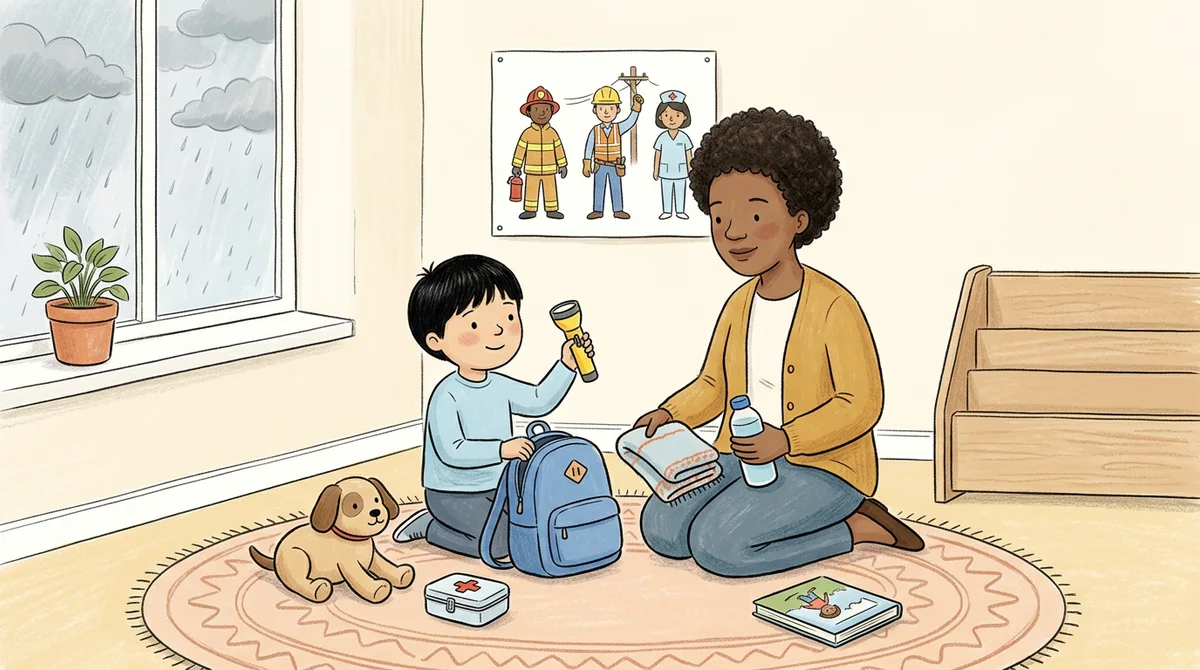
- Find the helpers and know the plan. In Helper Hunt (opens in a new tab), children find the people in a picture who can help after a storm, then watch Sam the firefighter put on gear one piece at a time. What Would Daisy Do? (opens in a new tab) and Safe or Not Safe? (opens in a new tab) rehearse safe choices. Send Pack Daisy's Go-Bag (opens in a new tab) and Daisy's Family Plan (opens in a new tab) home so that practice happens with a grown-up.
- Give caring somewhere to go. With Thank a Helper (opens in a new tab), children make and print a thank-you card for a line worker, a nurse or a neighbor. When the storm is far away and there is nothing to do, a kind wish still counts. Kind Wishes with Daisy (opens in a new tab) gives that wish a routine. Feeling for people in a storm is empathy. Wishing them well is compassion, and compassion is a muscle that needs exercise.
Preview the storm games first. For a child who has lived through a disaster, storm content can be frightening, so offer a choice. Keep the day's routine steady. Bring in your school counselor or social worker if a child's sleep, play or mood stays changed for weeks, if the worry is getting stronger, or if the child lost a home or a loved one.
How Daisy can help
| Step | What children see in Daisy & The Big Storm | Free games to pair |
|---|---|---|
| Calm | Daisy's refrain: "Ears up. Take a deep breath." | Breathe with Sirena (opens in a new tab), Calming Breaths (opens in a new tab) |
| Find the helpers | "Look around for the helpers." Sam the firefighter is one of them | Helper Hunt (opens in a new tab), What Would Daisy Do? (opens in a new tab) |
| Know the plan | Daisy's friends get through the storm in different safe ways: some leave, some find a safe spot nearby, some go with family | Who Goes Where? (opens in a new tab), Pack Daisy's Go-Bag (opens in a new tab), Daisy's Family Plan (opens in a new tab) |
| Know what is safe | Not tied to a scene we can confirm. Our pairing for after-storm safety | Safe or Not Safe? (opens in a new tab), True or Not True? (opens in a new tab) |
| Help and give thanks | Caesar the tortoise's house floats away, and friends and neighbors help | Build Caesar's House (opens in a new tab), Thank a Helper (opens in a new tab), Kind Wishes with Daisy (opens in a new tab) |
Where to find everything:
- Educator toolkit. The book is coming soon, and the Daisy & The Big Storm educator toolkit is live now with talking scripts, psychological first aid, media guidance and a family plan builder. Your classroom resources page has the read-alongs and printable guides.
- For families. Share the parent page and the kids practice app, which is free with no sign-up.
- Games. All 12 Big Storm games (opens in a new tab) are free in the browser. Each has a teacher card, such as the Breathe with Sirena card (opens in a new tab). The teacher documentation (opens in a new tab) lists them all, and Daisy's songs (opens in a new tab) include "Big Storm, Brave Heart."
- Print. The Daisy Activity Book (opens in a new tab) is a free PDF.
- Not sure where to start? The Find my Daisy kit navigator builds a set for your role and setting.
- Related reading. Feeling With and Caring For explains why empathy needs compassion alongside it.
The games are general safety, calming and kindness practice, not therapy. If a child seems very upset, involve your school counselor or social worker.
You cannot stop the storm or the news. You can be the calm voice that says what is true, and the one who points to the helpers.
Every study cited in this article is listed with a link in .
References
Sources are listed in APA style. Links open the original publication in a new tab.
Carpenter, A. L., Elkins, R. M., Kerns, C., Chou, T., Greif Green, J., & Comer, J. S. (2017). Event-related household discussions following the Boston Marathon bombing and associated posttraumatic stress among area youth. Journal of Clinical Child & Adolescent Psychology, 46(3), 331–342. https://doi.org/10.1080/15374416.2015.1063432 (opens in a new tab)
Cobham, V. E., McDermott, B., Haslam, D., & Sanders, M. R. (2016). The role of parents, parenting and the family environment in children's post-disaster mental health. Current Psychiatry Reports, 18(6), Article 53. https://doi.org/10.1007/s11920-016-0691-4 (opens in a new tab)
Comer, J. S., Furr, J. M., Beidas, R. S., Weiner, C. L., & Kendall, P. C. (2008). Children and terrorism-related news: Training parents in coping and media literacy. Journal of Consulting and Clinical Psychology, 76(4), 568–578. https://doi.org/10.1037/0022-006X.76.4.568 (opens in a new tab)
Dalton, L., Rapa, E., & Stein, A. (2020). Protecting the psychological health of children through effective communication about COVID-19. The Lancet Child & Adolescent Health, 4(5), 346–347. https://doi.org/10.1016/S2352-4642(20)30097-3 (opens in a new tab)
Hobfoll, S. E., Watson, P., Bell, C. C., Bryant, R. A., Brymer, M. J., Friedman, M. J., Friedman, M., Gersons, B. P. R., de Jong, J. T. V. M., Layne, C. M., Maguen, S., Neria, Y., Norwood, A. E., Pynoos, R. S., Reissman, D., Ruzek, J. I., Shalev, A. Y., Solomon, Z., Steinberg, A. M., & Ursano, R. J. (2007). Five essential elements of immediate and mid-term mass trauma intervention: Empirical evidence. Psychiatry, 70(4), 283–315. https://doi.org/10.1521/psyc.2007.70.4.283 (opens in a new tab)
La Greca, A. M., Lai, B. S., Llabre, M. M., Silverman, W. K., Vernberg, E. M., & Prinstein, M. J. (2013). Children's postdisaster trajectories of PTS symptoms: Predicting chronic distress. Child & Youth Care Forum, 42(4), 351–369. https://doi.org/10.1007/s10566-013-9206-1 (opens in a new tab)
La Greca, A. M., Silverman, W. K., Vernberg, E. M., & Prinstein, M. J. (1996). Symptoms of posttraumatic stress in children after Hurricane Andrew: A prospective study. Journal of Consulting and Clinical Psychology, 64(4), 712–723. https://doi.org/10.1037/0022-006X.64.4.712 (opens in a new tab)
Masten, A. S., & Narayan, A. J. (2012). Child development in the context of disaster, war, and terrorism: Pathways of risk and resilience. Annual Review of Psychology, 63, 227–257. https://doi.org/10.1146/annurev-psych-120710-100356 (opens in a new tab)
Midtbust, L. G. H., Dyregrov, A., & Djup, H. W. (2018). Communicating with children and adolescents about the risk of natural disasters. European Journal of Psychotraumatology, 9(Suppl. 2), Article 1429771. https://doi.org/10.1080/20008198.2018.1429771 (opens in a new tab)
National Child Traumatic Stress Network. (2017). Psychological first aid for schools (PFA-S) field operations guide. https://www.nctsn.org/resources/psychological-first-aid-schools-pfa-s-field-operations-guide (opens in a new tab)
Otto, M. W., Henin, A., Hirshfeld-Becker, D. R., Pollack, M. H., Biederman, J., & Rosenbaum, J. F. (2007). Posttraumatic stress disorder symptoms following media exposure to tragic events: Impact of 9/11 on children at risk for anxiety disorders. Journal of Anxiety Disorders, 21(7), 888–902. https://doi.org/10.1016/j.janxdis.2006.10.008 (opens in a new tab)
Pfefferbaum, B., Jacobs, A. K., Houston, J. B., & Griffin, N. (2015). Children's disaster reactions: The influence of family and social factors. Current Psychiatry Reports, 17(7), Article 57. https://doi.org/10.1007/s11920-015-0597-6 (opens in a new tab)
Pfefferbaum, B., Tucker, P., Pfefferbaum, R. L., Nelson, S. D., Nitiéma, P., & Newman, E. (2018). Media effects in youth exposed to terrorist incidents: A historical perspective. Current Psychiatry Reports, 20(2), Article 11. https://doi.org/10.1007/s11920-018-0875-1 (opens in a new tab)
Ronan, K. R., Alisic, E., Towers, B., Johnson, V. A., & Johnston, D. M. (2015). Disaster preparedness for children and families: A critical review. Current Psychiatry Reports, 17(7), Article 58. https://doi.org/10.1007/s11920-015-0589-6 (opens in a new tab)
Schonfeld, D. J., Demaria, T., Disaster Preparedness Advisory Council, & Committee on Psychosocial Aspects of Child and Family Health. (2015). Providing psychosocial support to children and families in the aftermath of disasters and crises. Pediatrics, 136(4), e1120–e1130. https://doi.org/10.1542/peds.2015-2861 (opens in a new tab)