
- Social-emotional learning
- Compassion
- Self-compassion
- Disasters and scary news
- Ages 4 to 10
When Children See Suffering
Empathy, compassion and self-compassion in disasters
Dr. Russ L'HommeDieu, DPT, C-AAIS and Karen L'HommeDieu, LMSW17 min readNatural-voice narration
Listen to this article
Read aloud in a natural voice. Pick any section to start there.
Introduction
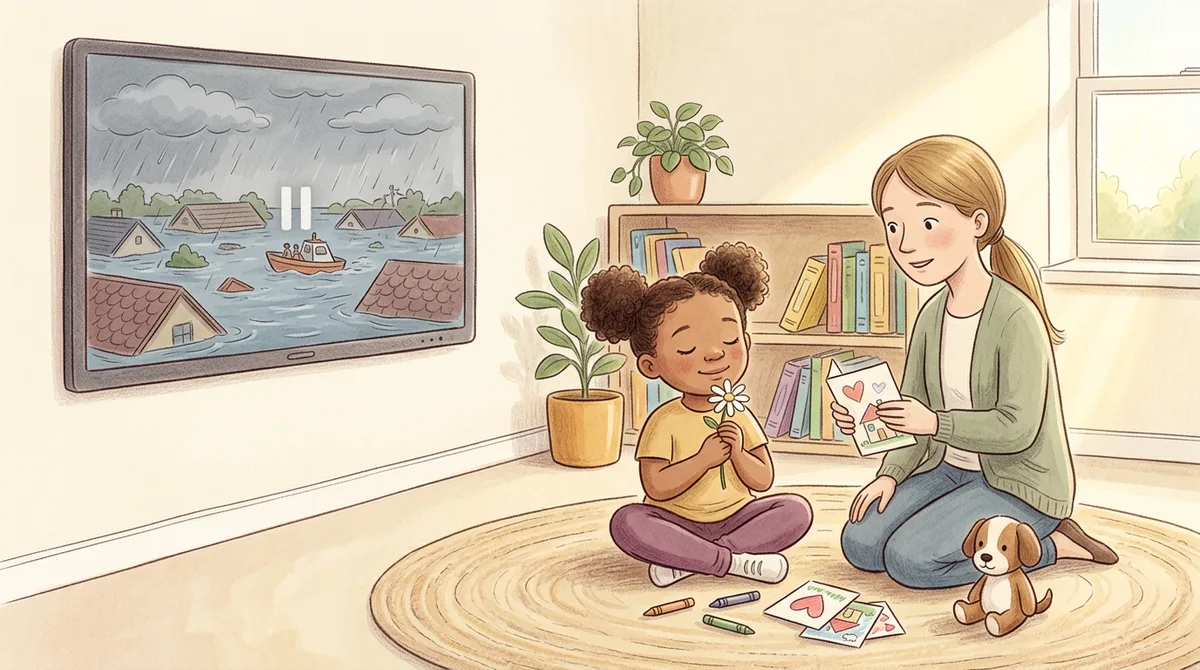
A child does not have to be in a disaster to be hurt by one. She sees a family on a rooftop on the evening news, or a classmate's house with a tree through it, and she feels it in her own body. That feeling is empathy, and it is a good sign. It is also a load that young children do not yet know how to carry.
Disaster planning for children usually covers supplies, drills and reunification. This article covers a quieter part of the plan: what to do with a child's feeling for the people she sees suffering. The research points to compassion training, with self-compassion at its center, as the skill that turns that feeling from distress into care.
Children are affected by disasters they only watch
Watching a disaster is a form of exposure. Three studies, across three decades and three kinds of events, reach the same conclusion.
- Oklahoma City, 1995. More than 2,000 middle school students were surveyed 7 weeks after the bombing. Among children with no physical or emotional connection to the event, the amount of bomb-related television they watched was directly related to their posttraumatic stress symptoms (Pfefferbaum et al., 2001).
- September 11, 2001. In 166 children with no direct exposure to the attacks, 5.4% met the study's threshold for symptomatic PTSD. Two things predicted higher risk: how much the child identified with the victims and, for younger children, how much television they watched (Otto et al., 2007).
- Hurricane Irma, 2017. In nearly 400 children ages 9 to 11, the "dose" of hurricane media predicted posttraumatic stress, including in children who lived far from the storm. Children whose brains reacted more strongly to fearful images before the hurricane were the most affected (Dick et al., 2021).
The September 11 finding deserves a second look. Identification with victims is close to what we mean by empathy: the child puts herself in the place of the person on the screen. One of the most human feelings a child can have is also one of the routes by which a distant disaster reaches her.
A broad review of children in disasters, war and terrorism adds context. Risk rises with the dose of exposure, most children recover, and the adults around the child are among the strongest protective factors (Masten & Narayan, 2012).
Empathy and compassion are different responses
Empathy is feeling with someone. Compassion is caring about their suffering and wanting it to ease. Researchers define empathy as sharing another person's feeling while still knowing the feeling belongs to that person. When that boundary is missing, the result is emotional contagion, which is already present in babies (Singer & Klimecki, 2014).
In child language:
- Empathy: "I feel scared and sad because those people look scared and sad."
- Compassion: "I see they are hurting. I care about them. I hope they are safe."
The two feel different in the body. Empathy for suffering hurts. Compassion is warm. Empathy is where caring starts, and a disaster is the hardest place for it to stop.
When empathy becomes distress
Shared feeling with no way to manage it turns into personal distress, and distressed children pull back. In a disaster the suffering is large, repeated on every screen, and far beyond a child's power to fix.
- Concern helps, distress hinders. In a study that tracked faces and heart rate while people watched others in need, children who showed concern were more likely to help. Children who showed distress were less likely to help (Eisenberg et al., 1989).
- Deep feelers carry real risk. One review calls empathy a "risky strength." In sensitive children it can lead to empathic personal distress and excessive guilt, which in turn raise the risk of anxiety and depression. The authors urge building healthy empathic skills early (Tone & Tully, 2014).
- Age changes the response. After a major earthquake in China, 9-year-olds gave more to others, and the more empathic they were, the more they gave. Six-year-olds became more selfish (Li et al., 2013). The youngest children may be the ones most likely to be flooded.
- Empathy practice alone can make people feel worse. When adults were trained only to resonate with videos of human suffering, their negative feelings rose (Klimecki et al., 2014).
You have seen what this looks like. One child cannot stop asking about the people on the news. Another refuses to talk about it at all. A third says, "It's not fair that we still have our house." None of them is being difficult. Each is carrying a feeling with nowhere to put it.
The other way out: going numb or turning people into "them"
Distress is not the only thing that can happen to empathy that has nowhere to go. The mind has a second way to stop the hurt: feel less. That can take two forms. Desensitization is feeling less about the suffering. Dehumanization is seeing the people who suffer as less like us. Both bring emotional relief, but emotional relief is not the same as emotional health.
Most of what we know about this comes from research with adults:
- Numbing is a way of coping. As the number of people in need goes up, the compassion people feel tends to go down. In three experiments, this "collapse of compassion" appeared when people expected the suffering of a large group to be overwhelming and turned their own feelings down in advance. In one experiment, people who were told to turn their emotions down felt less for a group than for one person. People who were told to let themselves feel their emotions did not: their compassion for the group held up (Cameron & Payne, 2011).
- It starts early in the count. In a series of studies on charitable giving, feeling and willingness to help were greatest for a single child in need, and the decline may begin with the second child. The authors link this to the apathy and inaction seen after large catastrophes (Västfjäll et al., 2014).
- Seeing less humanity "protects" the helper, at a cost. Among health care workers, those who saw a dying patient's suffering in more fully human terms reported more burnout symptoms, especially those with the most patient contact. The researchers concluded that seeing patients as less human can work as a shield, and they call it defensive dehumanization (Vaes & Muratore, 2013). The shield has its own cost to well-being. Cynicism, which in care work shows up as detachment from patients, is one of the three defining dimensions of burnout, alongside exhaustion and a sense of ineffectiveness (Maslach et al., 2001). So the helper pays either way: feel the suffering fully and be worn down, or pull back and slide into the detachment that is itself part of the suffering of burnout. Patients pay too. A meta-analysis of 82 studies covering 210,669 health care providers found that greater burnout was associated with poorer quality of care, including lower patient satisfaction, and with reduced patient safety. The effects were small to medium, and the studies show association, not cause (Salyers et al., 2017). What that study describes without naming it is empathic distress: feeling a patient's suffering fully, with no trained way to manage it. A growing body of research is showing that compassion training could be the perfect way for healthcare workers to deal with this problem. It is exactly the subject Dr. Russ is studying in his research on compassion training as an answer to burnout in health care.
- In children, the evidence is thinner. In 150 fourth and fifth graders, more exposure to video game violence was associated with lower empathy. The study could not show cause, and it did not find the same link for television, movies or real-life violence (Funk et al., 2004).
A disaster has every ingredient for this. The numbers are large, the pictures repeat, and the people are often far away and unfamiliar. A child who shrugs at the news, laughs at it, or says "that's just those people" may not be uncaring. She may have found the fastest way to stop a feeling that was too big.
A fair caution: the first three studies were done with adults, none of them tested children watching disasters, and the one child study shows association only. We are extending adult findings to children, and that is our reasoning, not a research result.
Three places empathy can go
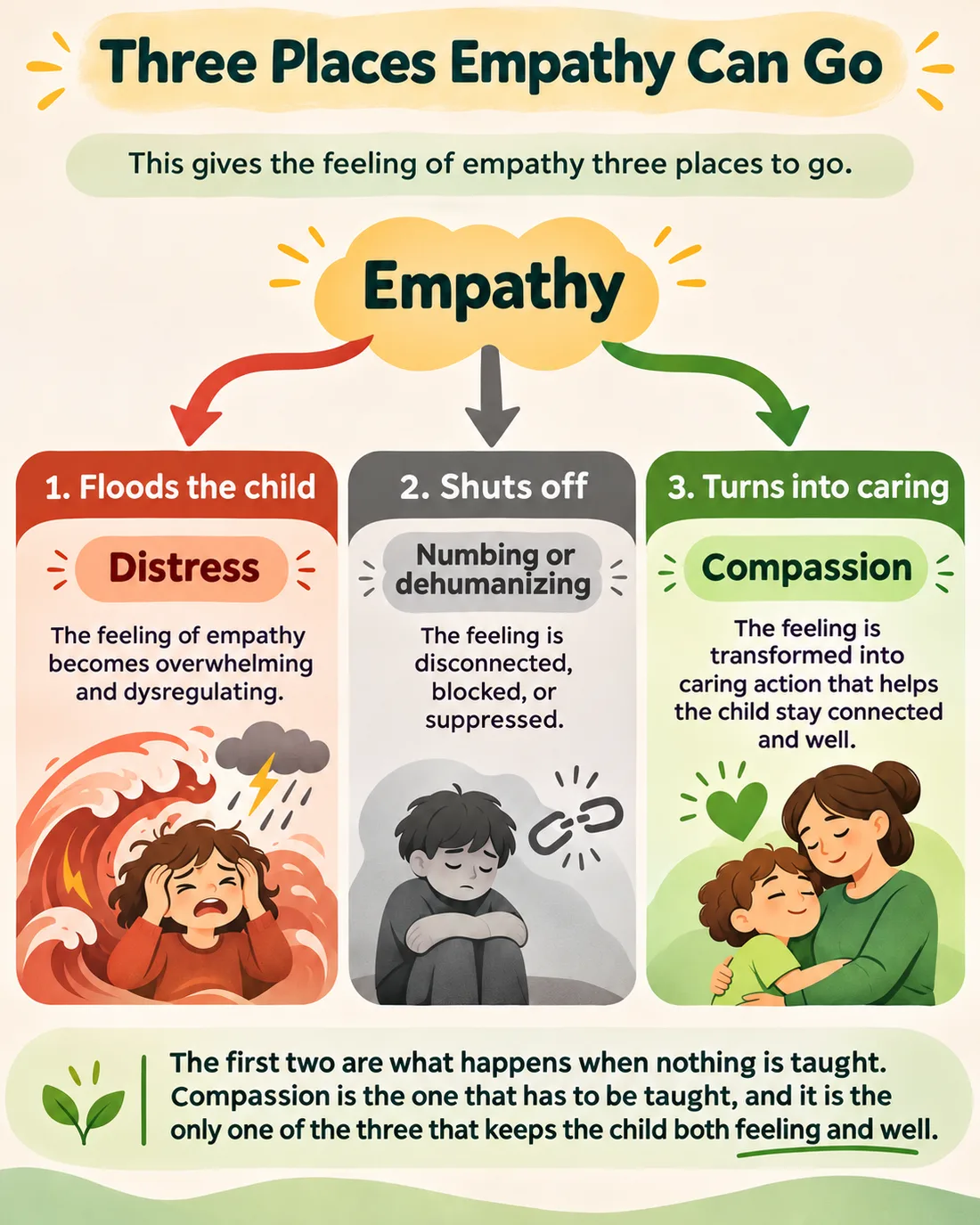
This gives a feeling of empathy three places to go. It can flood the child, which is distress. It can be shut off, which is numbing or dehumanizing. Or it can be turned into caring, which is compassion. The first two are what happens when nothing is taught. Compassion is the one that has to be taught, and it is the only one of the three that keeps the child both feeling and well.
Compassion training gives the feeling somewhere to go
Compassion works like a muscle: it gets stronger when it is used, and it can be trained before it is needed.
- Compassion reverses empathic distress. In the same adult study, compassion training that followed empathy training reversed the rise in negative feelings and increased positive ones. The participants were watching suffering they could do nothing about. The researchers describe compassion as a coping strategy that overcomes empathic distress and strengthens resilience (Klimecki et al., 2014).
- A few minutes of kind wishes. A brief loving-kindness exercise, which consists of silently wishing others well, increased adults' feelings of connection and positivity toward strangers (Hutcherson et al., 2008).
- Young children can learn it. A 12 week mindfulness-based Kindness Curriculum, tested in a randomized trial with 68 preschoolers, improved social competence. Children without it became more selfish over the same period (Flook et al., 2015).
- Adults can be coached. In a randomized study of 90 children ages 7 to 13, those whose mothers were trained in coping and media literacy showed lower threat perceptions after a frightening news clip than those whose mothers talked with them as usual (Comer et al., 2008).
This matters in a disaster because action is so often impossible. A child cannot rebuild a house or bring back a pet. If she learns that caring only counts when it fixes something, a disaster leaves her the two choices above: carry the distress or shut the feeling off. The sincere wish that someone be safe is already compassion. It gives her a third choice.
Self-compassion: the part that is easy to leave out
Self-compassion is compassion turned inward. In our view it belongs in any compassion training for children, because a disaster stirs up the very feelings it addresses: fear, guilt and helplessness.
Self-compassion has three parts (Neff, 2003):
- Self-kindness. Being gentle with yourself when you hurt, in place of harsh self-criticism.
- Common humanity. Knowing that your feelings are part of being human and that other people feel them too.
- Mindfulness. Noticing a painful feeling without pushing it away or being swept off by it.
Disasters stir up exactly the feelings these three parts answer. A child feels scared and thinks that is babyish. She feels guilty that her family is safe when others are not. She feels helpless because she cannot fix it. The "risky strength" review names excessive guilt as one of the two paths from empathy to anxiety and depression (Tone & Tully, 2014). Self-compassion speaks directly to that guilt.
The evidence so far comes from older children:
- After a disaster. Sixty-four adolescents exposed to the Mount Carmel forest fire in Israel were followed for 6 months. Those with more self-compassion went on to have fewer posttraumatic stress, panic and depressive symptoms, beyond what mindfulness alone explained (Zeller et al., 2015).
- Across many studies. A meta-analysis of 19 studies with 7,049 young people ages 10 to 19 found a large inverse relationship between self-compassion and anxiety, depression and stress (Marsh et al., 2018).
- It can be taught. In a pilot study with 34 teens, a 6 week mindful self-compassion course raised self-compassion and life satisfaction and lowered depression compared with a waitlist (Bluth et al., 2016).
A fair caution: these self-compassion studies involved adolescents, and two of the three show association, not cause. The brain imaging and kind-wish studies were done with adults. No study has yet tested compassion or self-compassion training as disaster preparation for young children. What the research does support is the sequence: empathy arrives on its own, distress follows when it has nowhere to go, and compassion for others and for oneself gives it somewhere to go.
When self-compassion is blocked, start with a loved one
Self-compassion belongs in compassion training and, for many children, it may be the hardest place to begin. The work of Thupten Jinpa offers a way around the block: start with someone the child already loves.
Jinpa, a former monk and the longtime English translator for the Dalai Lama, was the lead developer of Compassion Cultivation Training (CCT) at Stanford. The program orders its practices from easier to more difficult. After settling the mind, participants begin with loving-kindness and compassion for a loved one and learn to notice the physical feeling of warmth and concern. Only then do they turn that same feeling toward themselves, and after that toward strangers, difficult people and all beings (Brito-Pons et al., 2018). Jinpa's own account of the program treats self-compassion as a real challenge for many people and gives it a chapter of its own (Jinpa, 2015).
The logic is simple. Warmth toward a loved one is easy to find. Once a person knows what that warmth feels like in the body, it can be turned inward. The blocked door is opened from the other side.
The sequence has been tested as a whole. In a randomized trial, 100 adults were assigned to a 9 week CCT course or a waitlist. The study measured three directions of compassion: compassion for others, receiving compassion from others, and self-compassion. It concluded that specific domains of compassion can be deliberately cultivated through training (Jazaieri et al., 2013).
A fair caution, and it is an important one. This is adult research. The trial tested the whole program, not the order of its steps. No research shows that children need to start with a loved one, and no study has compared starting points in children at any age.
Our view goes beyond the evidence, so we label it as our view. Children grow up in a society that prizes performance and individual achievement. From an early age they are graded, ranked and compared, and many learn to meet their own mistakes with criticism instead of kindness. We think it is more than likely that this trains self-compassion out of children early, in favor of a more performance-oriented, individualistic mindset. If that is right, then by the time a child reaches your classroom, "be kind to yourself" may already feel strange, undeserved or babyish.
So in practice we suggest beginning where the warmth already is:
- Start with a loved one. Ask the child to picture someone she loves: a grandparent, a best friend, a pet. "What do you wish for them when they are sad?"
- Notice the feeling. "Where do you feel that wish in your body? That warm feeling is caring."
- Turn it around. "Now imagine they are wishing the same thing for you." Then: "Can you say that wish to yourself?"
- Do not force it. If the wish for herself will not come, stay with the loved one and try again another day. The muscle is still being exercised.
Try it with Kind Wishes with Daisy. Kind Wishes with Daisy (opens in a new tab) is a free kindness game on threepawspublishing.games. Children send good wishes to themselves, to people they love, and to the whole world, and each wish adds a petal to a daisy. The game opens with the wish for yourself. For a child who finds that wish hard, warm up before you press play: have her picture someone she loves, say one kind wish for that person out loud, and notice the warm feeling. Then start the game, so the wish for herself arrives with that warmth already in place. If she still skips or rushes the first circle, let her. Play it again another day and watch for the day the wish for herself comes easily.
A child in a disaster often cannot yet say "it is okay that I am scared." She can almost always say "I hope Grandma is safe." Start there.
What this looks like before, during and after a disaster
Teach the skills when the sky is clear, so they are ready when it is not. These practices are our suggestions drawn from the research above, not a tested program.
Before: build the muscle
- Teach the two words. "Feeling with" is empathy. "Caring for" is compassion. When you see either one in class, say which it was.
- Practice kind wishes on a schedule. A few minutes, once or twice a week: a wish for someone you love, then for yourself, for your class, for people far away. "May you be safe. May you feel loved."
- Teach self-compassion in three child-size steps. First ask what the child would say to a friend or a pet who felt this way. Then, hand on heart, she says it to herself: "This is a hard feeling." "Other kids feel this too." "I can be kind to myself." Rehearse it with small upsets, like a lost game or a scraped knee, so it is familiar before a big one.
During: protect and steady
- Limit the screen and share it. Media dose matters most for the youngest children (Otto et al., 2007). Turn off looping coverage. When children do see the news, sit with them, say a few true words, and point out the helpers.
- Calm the body first. A flooded child cannot care for anyone. Offer a slow breath, a quiet spot or a steady adult nearby before you talk about what happened.
- Name the feeling as caring. "You feel sad for that family because you have a kind heart. That feeling is caring." Then use the self-compassion steps for the child's own fear or guilt: "It is okay to feel scared. It is okay to be glad we are safe and sad for them at the same time."
After: give the caring somewhere to go
- Offer one small job. A card for a classmate, cans for a food drive, a thank-you drawing for a line worker. Action gives the feeling a place to land.
- When nothing can be done, send the wish. "We cannot fix their house. We can hold a kind wish for them." That is compassion too.
- Watch your deep feelers. The child who keeps asking, cannot sleep, or carries guilt needs steps 3, 5 and 6 most. If the worry lasts for weeks or gets in the way of daily life, involve your school counselor or social worker.
One more thing: let children see you do it. "I feel sad for those families too. I am putting my hand on my heart and taking a breath. Now I am going to send them a kind wish."
How Daisy can help
Daisy & The Big Storm carries the same message in story form: sometimes life feels scary, helpers are everywhere, and becoming a helper makes you feel brave. Daisy is a real three-legged therapy dog, and her stories are written for ages 4 to 10. The four Three Paws Publishing sites each cover one part of the plan.
| Step | What it builds | Where to find it |
|---|---|---|
| Calm the body | A steady breath before any talking | Calming Breaths (opens in a new tab) on threepawspublishing.games: sixteen breathing exercises paced for three age groups |
| Care for yourself and others | Kind wishes for yourself, the people you love and the wider world. If the wish for herself is hard, begin with the loved-one circle and come back to it | Kind Wishes with Daisy (opens in a new tab) on threepawspublishing.games: wishes for yourself first, then people you love, then the whole world |
| Learn the plan | Storm safety practiced when the sky is clear | Daisy & The Big Storm games (opens in a new tab) on threepawspublishing.games: twelve gentle storm-safety games |
| Teach and talk | Lessons, talking scripts, media guidance and a family plan builder | The Daisy & The Big Storm educator toolkit and its version for parents on threepawspublishing.education |
| Settle with quiet hands | A calm, absorbing activity after hard news | Draw Daisy (opens in a new tab) on threepawspublishing.art: a draw-along video with printable tracing and coloring pages |
| Meet a helper | A real therapy dog who shows what helping looks like | Books, videos and school visit requests at threepawspublishing.com (opens in a new tab) |
More for your classroom:
- All educator resources. Read-alongs, teacher's guides and the printable activity book are on your resources page at threepawspublishing.education.
- Related reading. Feeling With and Caring For explains why young children need both empathy and compassion.
- All games. Everything at threepawspublishing.games (opens in a new tab) is free in the browser with no account.
The games are general calming and feelings practice, not therapy. If a child seems very upset, involve your school counselor or social worker.
A child who hurts for people she has never met is showing you her best quality. Help her find the warmth she already has for someone she loves and turn it toward herself. Then help her turn the hurt into a wish and, when she can, into help.
Every study cited in this article is listed with a link in .
References
Sources are listed in APA style. Links open the original publication in a new tab.
Bluth, K., Gaylord, S. A., Campo, R. A., Mullarkey, M. C., & Hobbs, L. (2016). Making friends with yourself: A mixed methods pilot study of a mindful self-compassion program for adolescents. Mindfulness, 7(2), 479–492. https://doi.org/10.1007/s12671-015-0476-6 (opens in a new tab)
Brito-Pons, G., Campos, D., & Cebolla, A. (2018). Implicit or explicit compassion? Effects of compassion cultivation training and comparison with mindfulness-based stress reduction. Mindfulness, 9, 1494–1508. https://doi.org/10.1007/s12671-018-0898-z (opens in a new tab)
Cameron, C. D., & Payne, B. K. (2011). Escaping affect: How motivated emotion regulation creates insensitivity to mass suffering. Journal of Personality and Social Psychology, 100(1), 1–15. https://doi.org/10.1037/a0021643 (opens in a new tab)
Comer, J. S., Furr, J. M., Beidas, R. S., Weiner, C. L., & Kendall, P. C. (2008). Children and terrorism-related news: Training parents in coping and media literacy. Journal of Consulting and Clinical Psychology, 76(4), 568–578. https://doi.org/10.1037/0022-006X.76.4.568 (opens in a new tab)
Dick, A. S., Silva, K., Gonzalez, R., Sutherland, M. T., Laird, A. R., Thompson, W. K., Tapert, S. F., Squeglia, L. M., Gray, K. M., Nixon, S. J., Cottler, L. B., La Greca, A. M., Gurwitch, R. H., & Comer, J. S. (2021). Neural vulnerability and hurricane-related media are associated with post-traumatic stress in youth. Nature Human Behaviour, 5(11), 1578–1589. https://doi.org/10.1038/s41562-021-01216-3 (opens in a new tab)
Eisenberg, N., Fabes, R. A., Miller, P. A., Fultz, J., Shell, R., Mathy, R. M., & Reno, R. R. (1989). Relation of sympathy and personal distress to prosocial behavior: A multimethod study. Journal of Personality and Social Psychology, 57(1), 55–66. https://doi.org/10.1037/0022-3514.57.1.55 (opens in a new tab)
Flook, L., Goldberg, S. B., Pinger, L., & Davidson, R. J. (2015). Promoting prosocial behavior and self-regulatory skills in preschool children through a mindfulness-based Kindness Curriculum. Developmental Psychology, 51(1), 44–51. https://doi.org/10.1037/a0038256 (opens in a new tab)
Funk, J. B., Baldacci, H. B., Pasold, T., & Baumgardner, J. (2004). Violence exposure in real-life, video games, television, movies, and the internet: Is there desensitization? Journal of Adolescence, 27(1), 23–39. https://doi.org/10.1016/j.adolescence.2003.10.005 (opens in a new tab)
Hutcherson, C. A., Seppala, E. M., & Gross, J. J. (2008). Loving-kindness meditation increases social connectedness. Emotion, 8(5), 720–724. https://doi.org/10.1037/a0013237 (opens in a new tab)
Jazaieri, H., Jinpa, G. T., McGonigal, K., Rosenberg, E. L., Finkelstein, J., Simon-Thomas, E., Cullen, M., Doty, J. R., Gross, J. J., & Goldin, P. R. (2013). Enhancing compassion: A randomized controlled trial of a compassion cultivation training program. Journal of Happiness Studies, 14(4), 1113–1126. https://doi.org/10.1007/s10902-012-9373-z (opens in a new tab)
Jinpa, T. (2015). A fearless heart: How the courage to be compassionate can transform our lives. Avery.
Klimecki, O. M., Leiberg, S., Ricard, M., & Singer, T. (2014). Differential pattern of functional brain plasticity after compassion and empathy training. Social Cognitive and Affective Neuroscience, 9(6), 873–879. https://doi.org/10.1093/scan/nst060 (opens in a new tab)
Li, Y., Li, H., Decety, J., & Lee, K. (2013). Experiencing a natural disaster alters children's altruistic giving. Psychological Science, 24(9), 1686–1695. https://doi.org/10.1177/0956797613479975 (opens in a new tab)
Marsh, I. C., Chan, S. W. Y., & MacBeth, A. (2018). Self-compassion and psychological distress in adolescents: A meta-analysis. Mindfulness, 9(4), 1011–1027. https://doi.org/10.1007/s12671-017-0850-7 (opens in a new tab)
Maslach, C., Schaufeli, W. B., & Leiter, M. P. (2001). Job burnout. Annual Review of Psychology, 52, 397–422. https://doi.org/10.1146/annurev.psych.52.1.397 (opens in a new tab)
Masten, A. S., & Narayan, A. J. (2012). Child development in the context of disaster, war, and terrorism: Pathways of risk and resilience. Annual Review of Psychology, 63, 227–257. https://doi.org/10.1146/annurev-psych-120710-100356 (opens in a new tab)
Neff, K. D. (2003). Self-compassion: An alternative conceptualization of a healthy attitude toward oneself. Self and Identity, 2(2), 85–101.
Otto, M. W., Henin, A., Hirshfeld-Becker, D. R., Pollack, M. H., Biederman, J., & Rosenbaum, J. F. (2007). Posttraumatic stress disorder symptoms following media exposure to tragic events: Impact of 9/11 on children at risk for anxiety disorders. Journal of Anxiety Disorders, 21(7), 888–902. https://doi.org/10.1016/j.janxdis.2006.10.008 (opens in a new tab)
Pfefferbaum, B., Nixon, S. J., Tivis, R. D., Doughty, D. E., Pynoos, R. S., Gurwitch, R. H., & Foy, D. W. (2001). Television exposure in children after a terrorist incident. Psychiatry, 64(3), 202–211. https://doi.org/10.1521/psyc.64.3.202.18462 (opens in a new tab)
Salyers, M. P., Bonfils, K. A., Luther, L., Firmin, R. L., White, D. A., Adams, E. L., & Rollins, A. L. (2017). The relationship between professional burnout and quality and safety in healthcare: A meta-analysis. Journal of General Internal Medicine, 32(4), 475–482. https://doi.org/10.1007/s11606-016-3886-9 (opens in a new tab)
Singer, T., & Klimecki, O. M. (2014). Empathy and compassion. Current Biology, 24(18), R875–R878. https://doi.org/10.1016/j.cub.2014.06.054 (opens in a new tab)
Tone, E. B., & Tully, E. C. (2014). Empathy as a "risky strength": A multilevel examination of empathy and risk for internalizing disorders. Development and Psychopathology, 26(4, Pt. 2), 1547–1565. https://doi.org/10.1017/S0954579414001199 (opens in a new tab)
Vaes, J., & Muratore, M. (2013). Defensive dehumanization in the medical practice: A cross-sectional study from a health care worker's perspective. British Journal of Social Psychology, 52(1), 180–190. https://doi.org/10.1111/bjso.12008 (opens in a new tab)
Västfjäll, D., Slovic, P., Mayorga, M., & Peters, E. (2014). Compassion fade: Affect and charity are greatest for a single child in need. PLoS ONE, 9(6), Article e100115. https://doi.org/10.1371/journal.pone.0100115 (opens in a new tab)
Zeller, M., Yuval, K., Nitzan-Assayag, Y., & Bernstein, A. (2015). Self-compassion in recovery following potentially traumatic stress: Longitudinal study of at-risk youth. Journal of Abnormal Child Psychology, 43(4), 645–653. https://doi.org/10.1007/s10802-014-9937-y (opens in a new tab)