
- Social-emotional learning
- Empathy
- Compassion
- Empathic distress
- Ages 4 to 10
When the Feeling Is Too Big
Helping a child who is flooded by empathy
Dr. Russ L'HommeDieu, DPT, C-AAIS and Karen L'HommeDieu, LMSW2 min readNatural-voice narration
Listen to this article
Read aloud in a natural voice. Pick any section to start there.
A child who could not stop crying
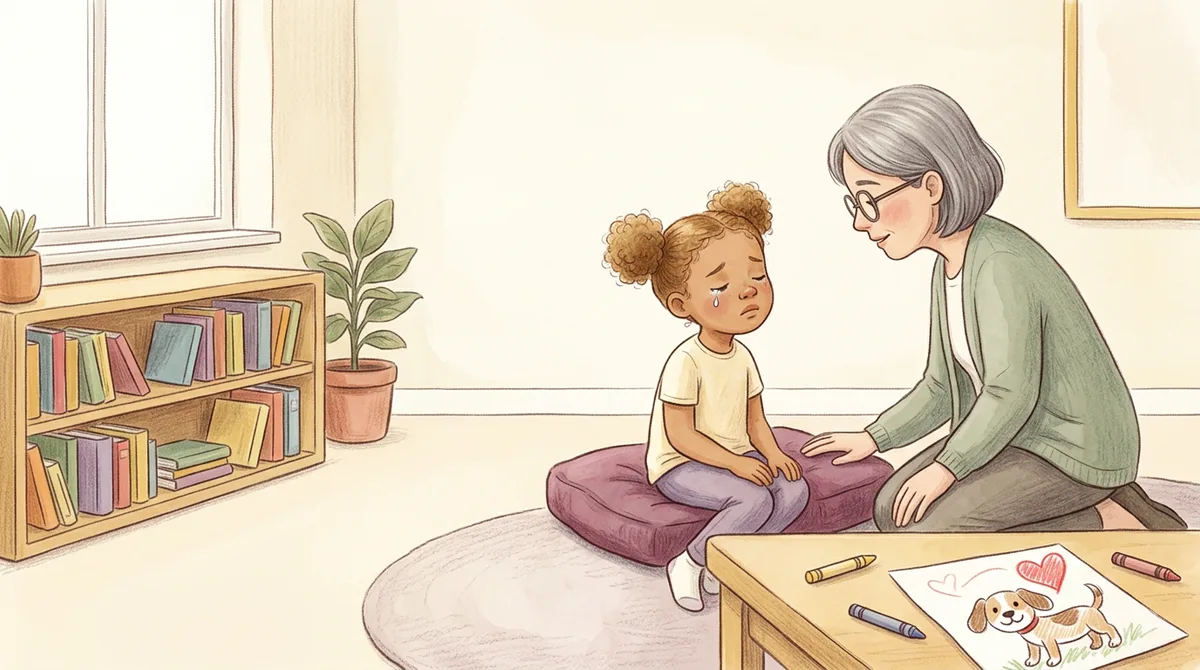
At one of Daisy's visits, a child suddenly said. "I feel so sorry for Daisy" and began to sob. She could not stop.
She was not misbehaving, and nothing was wrong with her. She felt Daisy's hurt as if it were her own, and the feeling had nowhere to go.
Researchers call this empathic distress, or personal distress. In one study there was some indication that children who showed distress at another's need helped less, while children who showed concern helped more (Eisenberg et al., 1989). A child who floods is a caring child who needs help carrying the feeling.
In the moment
These are our suggestions, not tested steps:
- Come close and stay calm. Get down to her level and speak slowly. Your steady voice does the first work.
- Name it without fixing it. "You feel so sad for Daisy. That is your caring heart."
- Slow the body. Breathe together, a few slow breaths at her pace. Calming Breaths (opens in a new tab) gives you a picture to breathe along with.
- Bring her back to now. The hurt happened long ago. Today Daisy is safe, loved and running. If Daisy is in the room and her handler says yes, let the child see for herself.
- Give the caring a job. Offer one kind wish to say together: "May Daisy be happy. May Daisy be safe. May Daisy not Feel Hurt." Creating a drawing for Daisy works too. If Daisy is there and her handler agrees, offer a healing touch: "Daisy feels better when you pet her. Would you like to pet her?"
- Do not rush or shame. Skip "you're okay" and "don't cry." Offer a quiet spot with an adult nearby, and let the class carry on.
How compassion practice may help
Compassion practice may help over time. Empathy is feeling with. Compassion adds warmth and the wish to help.
In adults, empathy training alone raised negative feelings in response to others' suffering, and compassion training afterward reversed that rise and increased positive feelings (Klimecki et al., 2014).
In a randomized study of 68 preschoolers, a 12-week Kindness Curriculum improved social competence (Flook et al., 2015). We found no study that tests compassion practice for children who flood like this. Our view is that short, regular practice gives the feeling a path before the next big wave. Try Kind Wishes with Daisy (opens in a new tab) for a few minutes, a few times a week, starting with someone she loves.
If a child floods often, takes a long time to settle, or the reaction seems tied to something in her own life, bring in your school counselor or social worker.
How Daisy can help
- Breathe. Calming Breaths (opens in a new tab) is free in the browser.
- Wish well. Kind Wishes with Daisy (opens in a new tab) guides children to send kind wishes.
- Related reading. Feeling With and Caring For explains why empathy needs compassion alongside it. Why Does She Only Have Three Legs? covers answering children's questions about disability.
The games are general kindness, feelings and inclusion practice, not therapy.
Every study cited in this article is listed with a link in .
References
Sources are listed in APA style. Links open the original publication in a new tab.
Eisenberg, N., Fabes, R. A., Miller, P. A., Fultz, J., Shell, R., Mathy, R. M., & Reno, R. R. (1989). Relation of sympathy and personal distress to prosocial behavior: A multimethod study. Journal of Personality and Social Psychology, 57(1), 55–66. https://doi.org/10.1037/0022-3514.57.1.55 (opens in a new tab)
Flook, L., Goldberg, S. B., Pinger, L., & Davidson, R. J. (2015). Promoting prosocial behavior and self-regulatory skills in preschool children through a mindfulness-based Kindness Curriculum. Developmental Psychology, 51(1), 44–51. https://doi.org/10.1037/a0038256 (opens in a new tab)
Klimecki, O. M., Leiberg, S., Ricard, M., & Singer, T. (2014). Differential pattern of functional brain plasticity after compassion and empathy training. Social Cognitive and Affective Neuroscience, 9(6), 873–879. https://doi.org/10.1093/scan/nst060 (opens in a new tab)